atelier · September 6, 2026
Inside the Atelier at Corvane
Up three flights of a narrow staircase, eleven people cut, pin and sew by north light. A morning with the cutters, the finishers and one very patient mannequin.
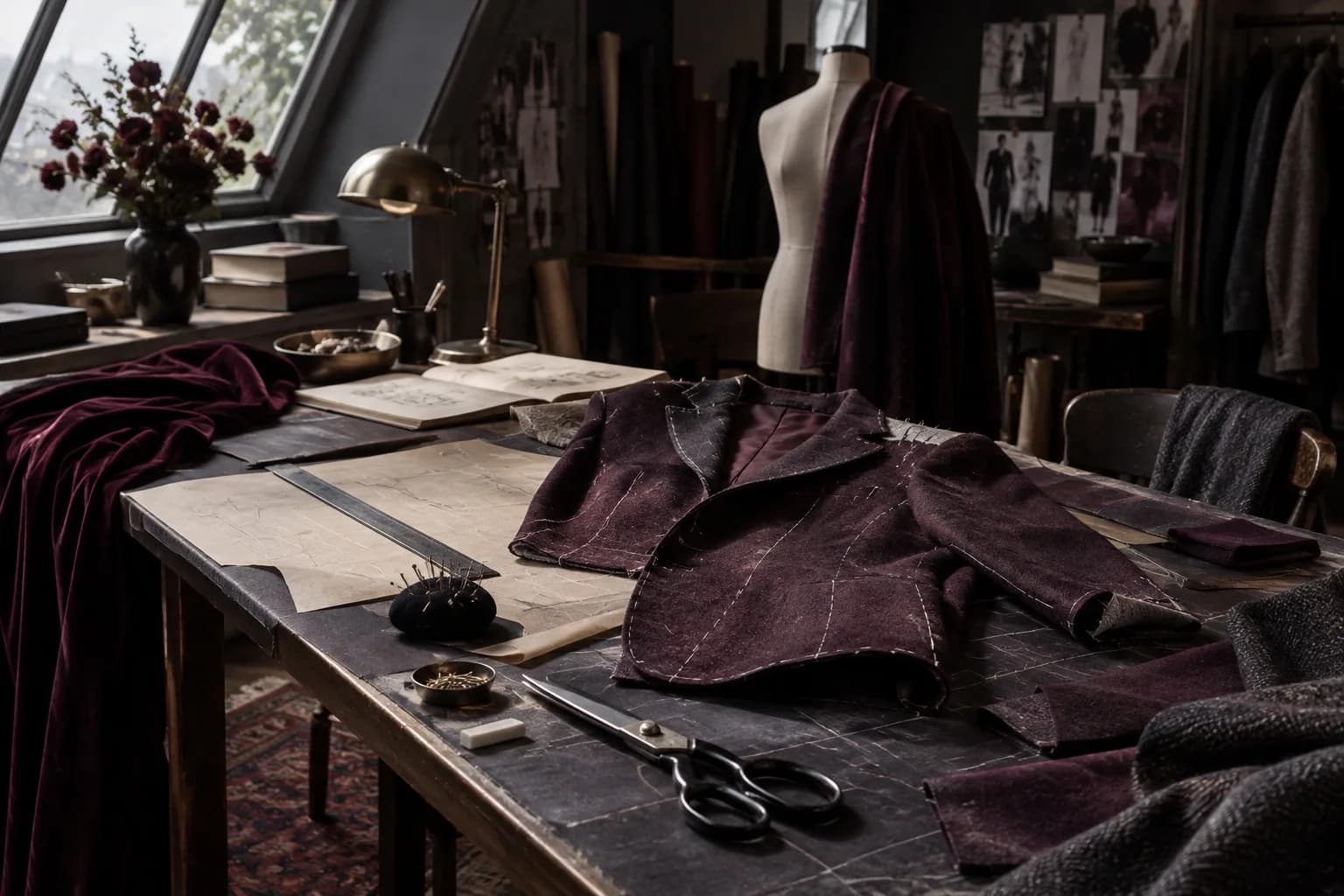
The staircase is the first test. It is narrow, steep, and wound around a lift that has not worked since before anyone can remember. At the top, a door that sticks. Behind it, a room so bright that your eyes need a moment to adjust.
This is the atelier at the House of Corvane. Eleven people work here. They cut, pin, baste, press and finish a few hundred garments a year, for clients who are patient enough to be measured twice.
The cutting table
At the centre is a table scarred by decades of chalk. Marguerite Esteve has stood at it since before I was a journalist. She does not use a computer to draw a pattern. She uses paper, a pencil that she sharpens with a small knife, and a grid of numbers she keeps in her head. "The body is not a spreadsheet," she says, which is the sort of remark that makes you want to write it down and then does not require writing down.
She spreads a bolt of wool, studies it, and cuts directly into it without apology. The shears are enormous and sound like someone closing a book.
The slow stitch
Behind her, a row of makers sit at low benches, working by hand. Basting is done in a pale thread that will later be pulled out. Collars are rolled over the thumb. Buttonholes are worked one at a time, with a twist of silk, each taking about twenty minutes. Nobody talks much. There is a radio on very low, and one of the sewers hums along without noticing.
Tomas Laurent, the head finisher, shows me a half-made jacket. Inside, the seams are bound in a silk that no one will ever see. "That is not for the customer," he says. "That is for the jacket." The distinction is, I realise, the whole philosophy of the place.
The fitting room
The fitting room is the smallest space and the busiest. There is a three-way mirror, a brass rail, a stool with a worn cushion, and a mannequin everyone calls Madame. She has been pinned, unpinned and re-pinned so many times she has her own sort of tenderness.
A client might come three or four times before a garment is done. The first fitting is for the fit. The second is for the line. The third is for the details that only the wearer can feel: the weight of a sleeve, the drop of a hem. By the fourth, the garment and the person have started to agree.
Why it matters
Corvane is not large. It will never be. It is the opposite of an industry that scales by cutting corners. Its customers return because the clothes get better with time and because the people who made them are still at the same table, in the same light.
I left with chalk on my sleeve, which no one at Velvet has asked me to brush off. If you want to know what the cloth upstairs is made of, read fabric weights, explained.
No comments yet
Comments are open. Have a thought or a question? Share it below.