outerwear · August 20, 2026
The Coat That Outlasts the Trend
A good coat is bought once and argued with for twenty years. On cut, cloth, lining and the small repairs that turn a purchase into a companion.
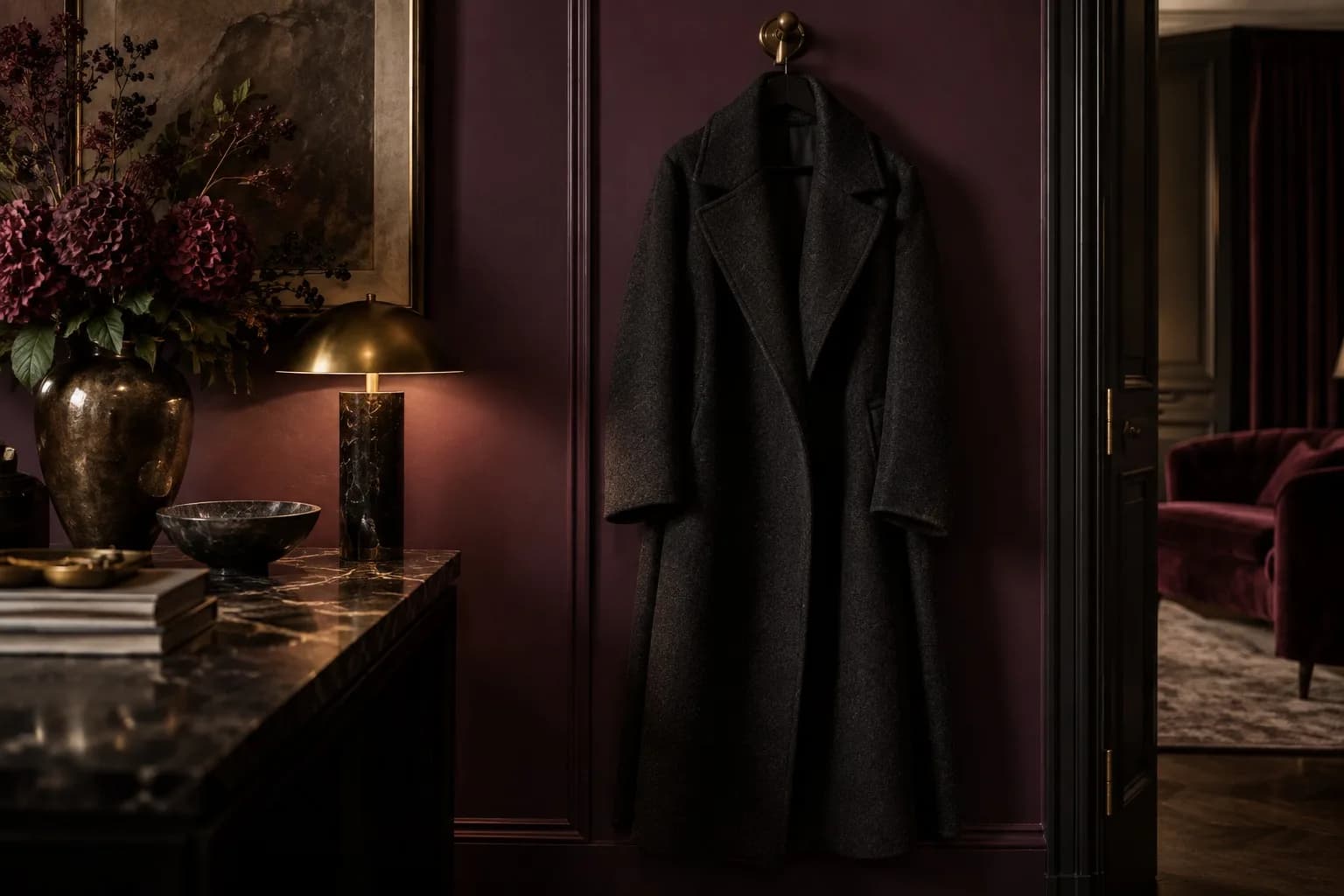
There is a particular coat that appears in every wardrobe worth envying: dark, long, slightly worn at the cuffs, and hung on the hook by the door as though it had always lived there. Nobody remembers the season it was bought. That is the entire point.
We keep returning to this coat in the pages of Velvet because it contradicts so much of what the industry tells us. It does not announce itself. It does not date. It merely improves, quietly, as the years add their patina.
Begin with the cut
A coat should be designed around the shoulder. Everything else is a negotiation. If the seam sits at the true edge of the bone, the sleeve falls clean and the collar hugs the neck, and the coat will carry its own weight rather than yours. If it does not, no amount of clever styling will rescue the line.
Look for restraint. A lapel of generous but unexaggerated width. A hem that falls somewhere sensible between knee and calf. Pockets deep enough to be useful and set low enough to suit your arms. The coats that date are the ones that said something loud in their year.
Then the cloth
Wool is the old argument and still the winning one. A dense, well-finished wool resists rain, holds heat, and recovers its shape after you have crushed it into a train seat. Run your thumb across the surface: it should feel plush rather than slick, and slightly resistant. Ask whether the pile lies in a single direction. Cheap cloth tends to sheen with wear. Good cloth merely softens.
Be wary of blends that save the maker money and cost you longevity. A small percentage of a second fibre can be useful, even wise. A cloth that is mostly something else is a coat that will not make it past its fifth winter.
The lining, which no one sees
Turn the coat inside out. The lining is the honesty of a garment. It should be cut generously, so the coat does not bind when you reach, and stitched with an easy pleat in the back for movement. A good lining is silk or a fine viscose or cupro. It has weight and slides over a sleeve. A bad one rustles like a carrier bag.
Check the seams. Check whether the hem is hand-finished or machined. Neither is wrong, but one of them tells you the maker had time.
What mending teaches
The best coats are the ones that have been repaired. A button re-sewn on a thicker thread, an elbow patched, a lining replaced in year twelve. Each repair is a small act of attention. We have come to believe that a wardrobe is less a collection of things than a record of how well you have looked after them.
Buy the coat once. Wear it until the cuffs go soft. Take it to a good tailor when the hem falters. And when someone says "that old thing?", smile. It has outlasted the question.
For a clearer sense of how heavy a cloth should be, fabric weights, explained without the jargon is the natural next page.
No comments yet
Comments are open. Have a thought or a question? Share it below.